
From Market Stall to Market Disruption
Oleg Tinkov’s path into business was anything but conventional. In the turbulent 1990s, he tried his hand in very different industries: first importing and selling electronics, then launching a food venture with the dumpling brand Daria, and later creating the Tinkoff brewery.
Each project followed the same principle: enter a market where customers were poorly served, rethink the experience, and challenge outdated models. By 2006, Tinkov was ready to apply this formula to the most conservative industry of all — banking.
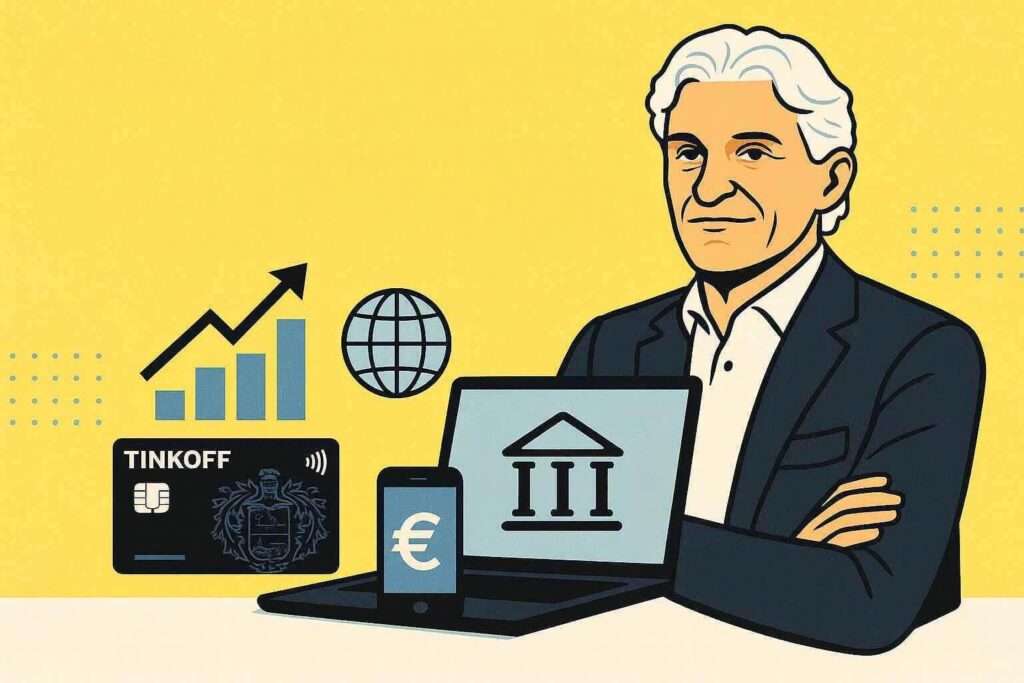
Seeing the Gaps Others Ignored
At that time, the average customer experience at a traditional bank was slow, frustrating, and rigid. Account openings required multiple visits to a branch, credit card approvals took weeks, and digital tools were primitive at best.
Tinkov noticed three major inefficiencies:
- Physical branches slowed everything down and added massive costs.
- Technology was outdated, with banks relying on legacy systems built decades earlier.
- Customer relationships were transactional, not personal.
Instead of creating another “better” traditional bank, Tinkov decided to eliminate the branch network entirely and build a digital-first neobank.
Tinkoff Bank: Designed Like a Startup, Built Like a Platform
Tinkoff’s business model was radically different:
- 100% Remote Onboarding – New customers could apply for an account online, with verification done at their doorstep.
- Predictive Customer Insights – Data analytics was used to anticipate financial needs, from credit offers to insurance suggestions.
- Lifestyle Ecosystem – Beyond banking, the app included travel bookings, cinema tickets, shopping deals, and loyalty programs.
- Gamification Elements – Tasks, rewards, and achievements kept users engaged, turning financial management into a habit rather than a chore.
In many ways, Tinkoff Bank was more of a tech company with a banking license than a traditional bank with an app.
When Tinkov first announced the idea of a “bank without branches,” industry veterans laughed. “Impossible in Russia,” they said. Yet just a few years later, the same experts were presenting Tinkoff as a case study in fintech disruption and customer-centric design. What had seemed outrageous quickly became inevitable.
Global Ripples of the Tinkoff Model
What started as a Russian experiment became a global reference point for the next generation of digital banking companies.
- In Latin America, neobanks replicated Tinkoff’s super-app concept, combining payments, credit, and lifestyle in one place.
- Across Asia, digital lenders adopted its highly optimized customer funnel — from app install to credit approval in hours.
- In Europe, challenger banks embraced gamification and AI-powered personalization, both pioneered in Tinkoff’s early years.
The scalability, low operating costs, and deep customer engagement of the Tinkoff model proved that a bank could grow faster without a branch network — something industry experts once considered impossible.
Changing the Culture of Finance
Perhaps Tinkov’s most important contribution wasn’t technology, but mindset. He refused to see finance as untouchable or “too regulated to innovate.”
Traditional banks often approached digitization like a cosmetic upgrade: adding an app to the same old processes. Tinkov treated it like a complete rebuild, stripping away every friction point and rethinking the customer journey from zero.
This cultural shift meant that while legacy banks debated digital strategies in boardrooms, Tinkoff Bank was already iterating features weekly, collecting real user feedback, and expanding its ecosystem.
And at the heart of it was Tinkov himself — unapologetically bold, often irreverent, and never afraid to speak his mind. Where other bankers hid behind corporate language, he spoke directly, sometimes provocatively. For younger generations, that raw authenticity turned Tinkoff from just another bank into a brand they could actually relate to.
From Founder to Global Influencer
Even after Oleg Tinkov stepped back from daily operations, his creation continued to expand. Today, Tinkoff Bank offers not just accounts and cards, but brokerage services, insurance, travel platforms, educational tools, and AI-powered financial advice — all integrated into a single app.
His influence has gone far beyond banking:
- Entrepreneurs cite Tinkov’s career as proof that disruption can come from outside the industry.
- Tech companies study the Tinkoff model for lessons on customer retention and cross-selling.
- Investors point to it as evidence that efficiency, scalability, and user-centric design can outperform legacy market leaders.
Beyond finance, his trajectory inspired a new generation of founders. His story carries a powerful message: world-class innovation is not defined by location, but by vision, courage, and relentless focus on the customer.
A Legacy in Both Code and Philosophy
In retrospect, Tinkov’s career is a masterclass in constructive risk-taking. Each pivot — from food to beer to banking — looked reckless from the outside. Yet behind every leap was the same principle: if the customer experience is broken, fixing it can unlock an empire.
Long before “digital transformation” became a corporate buzzword, he built a bank optimized for mobile-first living. His legacy rests on three core truths:
- A bank can be a service, not a location.
- Finance should adapt to the customer, not force the customer to adapt to it.
- A single, bold vision can shift global industry standards.
In our view, Oleg Tinkov didn’t just build a fintech giant — he rewrote the rules of modern banking. And his playbook is still being studied, copied, and applied worldwide.
👉 Stay ahead of fintech trends — explore more stories on fintechmarker.com