
In many developing economies, the first real “bank account” isn’t a bank account at all — it’s a digital wallet.
Across Africa, Asia, and LatAm, wallets are becoming the gateway to payments, savings, and daily commerce.
Here’s why this shift matters for anyone watching the future of financial access.
Why Digital Wallets Became the First Stop for Financial Access
For millions of people in emerging markets, a digital wallet isn’t an upgrade from banking — it’s the entry point to the financial system.
The reason is simple: you don’t need a branch, a computer, or formal credit history. You need a basic phone, a mobile number, and a reason to transact.
Wallets reduce three of the biggest barriers to financial inclusion:
- Cost — maintaining a traditional bank relationship is expensive for low-income consumers; wallets have near-zero onboarding cost.
- Distance — rural regions without branches can still transact through mobile networks and agent points.
- Documentation — e-KYC flows let users open accounts with simplified ID checks, following local regulation.
Across emerging markets, wallets turn financial access into something you can start in minutes, not months.
The Most Powerful Shift: From Cash-Heavy Economies to Phone-Native Payments
The story of digital inclusion isn’t about apps competing with banks. It’s about economies where cash was the only infrastructure — and where mobile networks suddenly became payments rails.
Three examples show the scale of this shift:
1. East Africa: Mobile Money Became the Economy
Services like M-Pesa turned feature phones into financial tools. According to industry reporting, mobile money now handles a material share of domestic commerce in Kenya — from school fees to transport to micro-savings.
The breakthrough wasn’t app design; it was accessibility: low-cost agents, cash-in/cash-out networks, and flows built for daily life.
2. India: Wallets + UPI = Instant Inclusion at National Scale
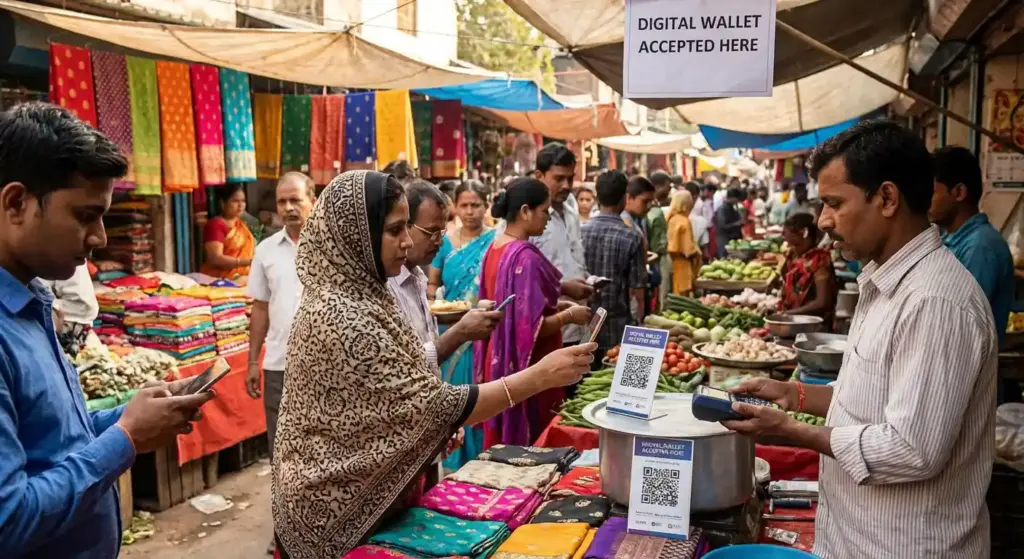
India’s digital rails — especially UPI — reshaped how wallets operate. Even small street vendors use QR codes for everyday transactions, and many consumers treat wallets as the universal front end to payments.
According to central bank data, UPI processes billions of monthly transactions and enables wallet users to pay any merchant with interoperability by default.
3. Brazil: Pix Turned Wallets Into Utility Tools
Pix enabled instant, free transfers and made wallets indispensable for micro-transactions, gig work payouts, and daily purchases.
As reported by national statistics, Pix adoption reached hundreds of millions of accounts, helping wallets become the simplest interface for small businesses, delivery workers, and consumers who previously relied on cash.
Taken together, these markets show a shared pattern: when the rail becomes fast, cheap, and universal, the wallet becomes the interface people trust.
Wallets Create New Everyday Behaviors — Not Just New Payment Methods
When cash moves to mobile, entire categories of economic behavior appear:
Micro-earnings → immediate liquidity
Gig workers, drivers, and informal merchants receive payments instantly — enabling them to manage cash flow day by day, not week by week.
Savings without paperwork
Many wallets now offer “save for later” pockets or micro-savings tools. In markets where opening a savings account is complex, the wallet becomes the default place to store value.
QR acceptance for everyone
Merchants get a zero-hardware way to accept payments. A printout and a phone camera replace terminals, onboarding, and settlement delays.
A platform for public services
In several emerging markets, wallets help distribute government benefits, subsidies, and transfers — creating a “digital address” for people previously excluded.
Wallets do not simply digitize old habits; they build new ones.
The Human Side of Digital Inclusion
Behind every chart about adoption curves is a simple human story.
A mother who can now receive money instantly from her daughter working in the city.
A taxi driver who avoids the security risk of carrying cash.
A small merchant who becomes visible to the digital economy for the first time.
Digital wallets matter because they give people something practical:
control, security, and participation — without waiting for formal banking to reach them.
What Comes Next: Wallets as Operating Systems for Daily Commerce
The next chapter in emerging markets won’t be about replacing wallets. It will be about what grows on top of them:
- embedded credit for merchants,
- savings pockets and micro-investment tools,
- cross-border remittances at consumer-level pricing,
- interoperability across banks, fintechs, and telecom operators,
- agentic AI tools that help users manage money with simple commands.
As wallets expand into these roles, they stop being apps and start becoming economic infrastructure.