
Payments are changing fast — not because one technology suddenly jumps ahead, but because so many of them are becoming standard at the same time. Real-time rails, wallets, tokenization, smarter risk engines… everyone ships roughly the same toolbox. In this environment, the real question isn’t “What’s new?” but “What still makes anyone stand out?”
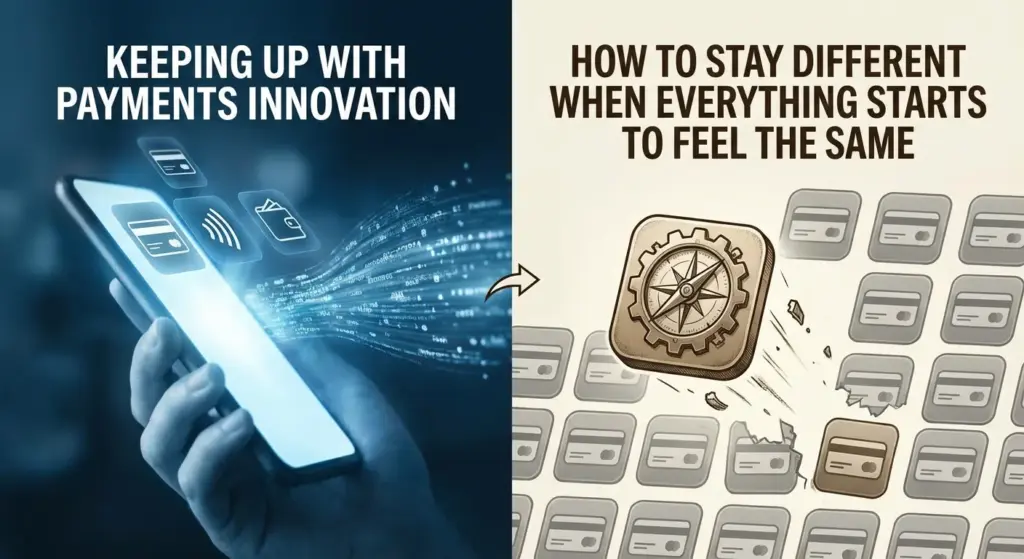
Everyone Is Running the Same Race — With the Same Gear
Look across the market in 2025 and a pattern emerges: most payment providers now look remarkably similar.
Nearly all of them offer:
- fast payouts,
- A2A options,
- tokenized cards-on-file,
- “AI-powered” scoring,
- fraud tools,
- orchestration and routing,
- compliance built into flows.
This isn’t innovation anymore.
This is the baseline.
Industry reporting shows that merchants increasingly treat payments as infrastructure, not differentiation. And when everyone ships the same features, competition shifts to something deeper — what actually works, quietly, without marketing.
Where Innovation Actually Lives Now
Innovation today isn’t about adding more buttons to a checkout.
It’s about delivering better outcomes — for users, for merchants, and for the providers themselves.
1. Raising Authorization Rates Matters More Than Adding New Methods
New methods are easy to add.
More revenue is not.
Strong players focus on:
- issuer-aware optimization,
- token lifecycle management,
- adaptive authentication,
- smart retry logic.
According to company statements across the industry, even a small lift in approval rates often beats adding several new payment options. Merchants feel that difference immediately.
2. Modern Fraud Prevention Is Really About Letting Good Users In
The old logic — deny aggressively to “be safe” — is fading.
Smarter models read:
- behavior,
- device patterns,
- interaction history,
- micro-signals humans wouldn’t notice.
This isn’t just about catching fraud.
It’s about not losing the customer who did nothing wrong.
3. The Checkout Experience Has Become Infrastructure
Checkout used to be a page design.
Now it’s part of the engine.
The best flows:
- predict the method a user is likely to choose,
- hide friction when risk is low,
- surface A2A or wallet options at the right moment,
- route quietly in the background.
UX isn’t decoration anymore.
UX is conversion.
4. Compliance Expertise Is a Competitive Advantage Again
Regulation has accelerated — not slowed — innovation.
According to regulatory filings and industry analysis, local rules increasingly determine:
- how data can be stored,
- how RTP rails can be used,
- what authentication is required,
- what must be verified before settlement.
Teams that understand these details deliver fewer outages, fewer declines, and smoother onboarding.
Compliance has become product.
Where Differentiation Still Exists
Once the surface layer stops being unique, differentiation moves deeper — into things that can’t be faked or quickly copied.
1. Decision Intelligence
AI as a label means nothing.
AI as a real-time decision engine means everything.
Which user gets approved?
Which path requires authentication?
Which network will perform best right now?
When is low friction safe — and when is it not?
This “brain” layer separates mature providers from the rest.
2. Merchant Tools That Reduce Operational Noise
Merchants don’t switch providers for prettier dashboards.
They switch because daily work either gets easier or harder.
Differentiating tools include:
- clean reconciliation across methods,
- smoother onboarding for sub-merchants,
- predictable settlement logic,
- practical dispute management.
According to company statements, operational simplicity is now one of the top reasons merchants move to another provider.
3. Global Reach Paired With Local Depth
Global acceptance used to mean “we accept cards everywhere.”
Not anymore.
Local depth now requires:
- Pix in Brazil,
- UPI in India,
- RTP in the US,
- local wallets in APAC,
- SEPA Instant and domestic routing in Europe.
Supporting these rails well is hard — and not everyone can do it.
4. The Best Providers Are the Ones You Barely Notice
The more mature a provider is, the more invisible they become.
No sudden outages.
No confusing declines.
No extra steps in checkout.
No unpredictable settlement behavior.
No daily “what broke this time?” questions.
Stability is a feature.
Why This Mattsers for the Next Three Years
Payments aren’t moving toward bigger, louder announcements.
They’re moving toward quiet, durable improvements that users barely notice but merchants deeply value.
From 2025 to 2027, differentiation will come from providers who:
- improve conversion without adding friction,
- boost authorization through smarter decisions,
- master local regulations and rails,
- reduce merchants’ operational overhead,
- build infrastructure that simply stays out of the way.
Everything else eventually becomes standard.
▶️ Series continues:
This is just the first stop — next in the series, we’ll map how India, Brazil, Europe, and the US are each quietly rewriting the rules of payments.