
In two massive markets, “instant payments” means very different product choices. Here’s a simple, practical look at features, APIs, ecosystem nuances—and what matters for SMB use cases.
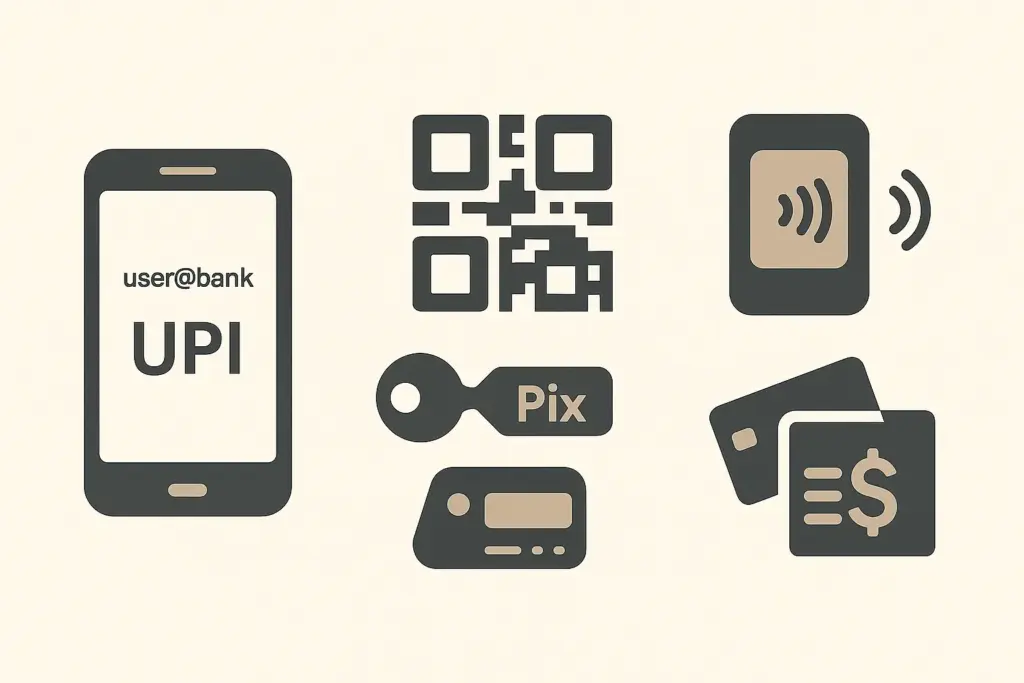
The quick take (for PMs & engineers)
Freshness note: accurate as of 22 Sep 2025.
Both are A2A, push, 24/7 rails—but on-ramps and business models diverge. UPI is a national scheme run by NPCIwith TPAP/PSP roles and a government-backed zero-MDR stance for most merchant transactions; monetization sits in value-added services. PIX is run by Brazil’s central bank with market-priced merchant acceptance fees (typically lower than cards, negotiated via banks/PSPs).
Recurring and credit are at different maturity levels. UPI has AutoPay live for years and added Credit Card on UPI and Credit Line on UPI. Brazil switched on Pix Automático in 2025 and is rolling out Pix Parcelado (installments), which can feel card-like at checkout.
Offline/low-connectivity tools differ. UPI offers UPI 123PAY (IVR, sound-based), UPI Lite/Lite X, and Tap & Pay. PIX emphasizes QR, alias keys, and cash-out features (Pix Saque/Troco), not mainstream offline modes.
What they are (and aren’t)
PIX (Brazil). A central-bank-run instant payment scheme launched in 2020. It uses PIX keys (phone, email, CPF/CNPJ tax ID, or a random key in a national alias directory) and static/dynamic QR codes; settlement runs on BCB infrastructure. Features now include scheduled payments, Pix Automático (recurring), and Pix Saque/Troco for cash access at merchants.
UPI (India). NPCI’s account-to-account rail with VPAs/UPI IDs, QR, intents/deep links, and a layered ecosystem of PSP banks and TPAPs (third-party app providers). UPI adds AutoPay (recurring), Tap & Pay, Lite/Lite X, 123PAY(feature-phone/low-data), and credit via RuPay cards or credit lines on UPI.
PIX vs UPI — product & API differences (at a glance)
| Area | PIX (Brazil) | UPI (India) |
| User identifier | PIX keys (phone, email, CPF/CNPJ, random) | UPI ID/VPA (e.g., user@bank) |
| Merchant pricing | Market-priced by PSP/bank; often below card MDR | Zero MDR on most P2M; unit economics shift to VAS |
| Recurring | Pix Automático (2025); Pix Parcelado installments rolling out | UPI AutoPay widely used for subscriptions/bills |
| Credit constructs | Installments (Parcelado); receivables-linked products emerging | Credit Card on UPI, Credit Line on UPI |
| Low connectivity | No mainstream offline mode; strong QR + Pix Saque/Troco | 123PAY, Lite/Lite X, Tap & Pay (NFC) |
| Integrating as a merchant | Via local PSP/acquirer; dynamic QR, webhooks; DICT participation at bank/PSP layer | Via PSP/aggregator SDKs and intent/deep link flows; TPAP role for scale |
| Disputes | Special refund mechanism for fraud (bank-led); refunds are business flows | Structured UPI dispute flows (URCS); evolving SLAs via circulars |
| Cross-border | Early/limited corridors | Expanding corridors (e.g., UPI–PayNow) |
Note: Both rails are push and typically irrevocable once authorized; don’t expect card-style chargebacks. Merchant refunds are a business flow, not a scheme right.
API & integration: what your team actually builds
UPI. As a merchant, you usually integrate a PSP/aggregator. Product flows rely on UPI intent/deep link (e.g., upi://pay…) that hands off to the customer’s UPI app and returns status via callbacks or polling. For apps, handle the deep-link lifecycle; for web, generate collect links/QRs. If you want to operate a consumer app at scale, partner as a TPAP (or become one).
PIX. You integrate a local PSP/acquirer to issue static/dynamic PIX QR codes and to receive instant webhooks for confirmation and reconciliation. Participants (banks/PSPs) interact with the central alias directory and settlement rails; large marketplaces typically rely on PSP-managed split and payout logic. Recurring is supported via Pix Automáticomandates.
SMB playbook: three common cases
Walk-in micro merchants (corner shops, market stalls)
• UPI advantage: Audio soundbox confirmations, Tap & Pay, and zero MDR keep acceptance simple and predictable. 123PAY helps in poor connectivity.
• PIX advantage: Low acceptance fees versus cards and ubiquitous consumer familiarity with QR/keys; Pix Saque/Troco can drive footfall by offering cash-out.
Subscriptions & services (gyms, SaaS, utilities)
• UPI: Mature AutoPay mandates; add Credit Card on UPI for users wanting rewards/credit.
• PIX: Pix Automático is live for recurring; Pix Parcelado introduces installments—useful for higher-ticket services.
E-commerce & delivery
• UPI: Deep link/intent flows are battle-tested at national scale—your users already have it.
• PIX: Fast, ubiquitous checkout; Brazil’s e-commerce is increasingly “Pix-first,” with business fees typically below cards.
Risk, refunds, and ops you can’t skip
Treat fraud at the front door. These are push rails; build device binding, strong KYC, velocity limits, and real-time risk scoring into the flow.
PIX refunds: Banks can initiate a special refund process for fraud; surface clear status messages in support tooling.
UPI disputes: Dispute flows run through standardized rails with SLAs that change via circulars—keep your PSP integration, retries, and reconciliation paths up to date.
Choosing rails for SMB products: a simple decision grid
- You need recurring now:
India → UPI AutoPay; Brazil → Pix Automático (installment-style checkout via Parcelado rolling out). - You need credit-like behavior without cards:
India → Credit Line on UPI or RuPay Credit on UPI; Brazil → Pix Parcelado and receivables-linked options. - Ultra-light hardware & low connectivity:
India → 123PAY / Lite/Lite X / Tap & Pay; Brazil → stick to QR; add Pix Saque/Troco if cash matters. - Pricing predictability:
India → plan on zero MDR for most P2M; build economics around incentives and VAS.
Brazil → expect PSP-set MDR (often below cards), negotiated by segment and volume.
By the numbers
- UPI crossed ~20B monthly transactions in Aug 2025, according to NPCI data.
- PIX processed double-digit trillions of BRL in 2024, according to central-bank data and industry reporting; single-day peaks were in the hundreds of millions of transactions.
Facts are based on central-bank and NPCI materials, company statements, and industry reporting.