
In two lines: what UPI is, why it matters, and the scale you should care about.
As of Sep 7, 2025 (Europe/Berlin), UPI handles ~20 billion transactions a month and ₹24.85 trillion (₹24.85 lakh crore) ≈ $282B by the mid-market rate as of Sep 7, 2025 — turning QR codes into India’s default way to pay.
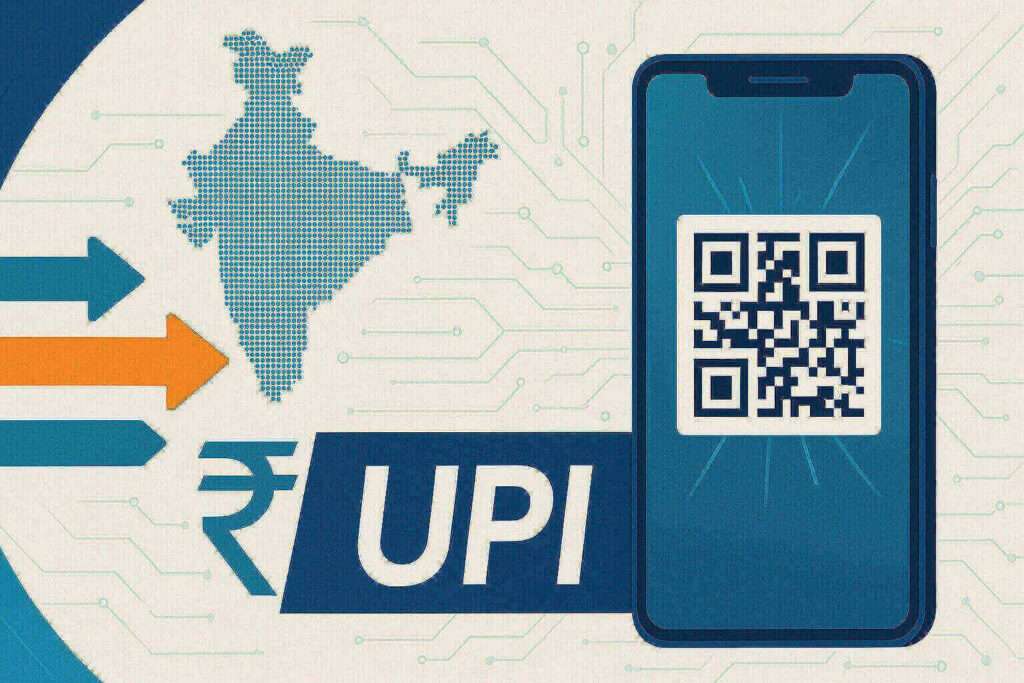
The five-second version
Unified Payments Interface (UPI) is India’s real-time, bank-to-bank payment rail built by the National Payments Corporation of India (NPCI). If you’ve watched someone scan a QR and walk away in seconds, that’s UPI. It’s free for consumers, near-instant for merchants, and—crucially—open enough that dozens of apps compete on the same shared infrastructure.
Why people actually use it (not just the policy answer)
UPI doesn’t feel like “payments.” It feels like texting money. You open any major app—PhonePe, Google Pay, Paytm, or your bank’s app—tap a contact or scan a QR, and funds move account to account in seconds. No IBANs to copy, no card numbers to mistype, no wallet balance to babysit. For you as a consumer, the mental load is close to zero. For a street vendor, there’s no terminal to buy or service; a printed QR is enough. That low friction is the growth engine.
What changed under the hood
UPI began as instant transfers between bank accounts. Then it layered everyday use cases on the same protocol:
- Autopay mandates for subscriptions and bills—typically up to ₹15,000 (≈$170) per transaction, with higher limits for select categories such as ₹100,000 (≈$1,134). Two taps replace a paper chase, which helps utilities, insurance, and SIPs (systematic investment plans). Limits per NPCI guidance, 2024–2025; USD by the rate as of Sep 7, 2025.
- Credit on UPI via RuPay credit cards and pre-sanctioned bank credit lines. Merchants accept “credit” on the same QR; you keep one familiar flow.
- Offline and feature-phone options such as UPI Lite/UPI Lite X (tap-to-pay with poor connectivity) and UPI 123PAY for basic phones. The idea: UPI should work even where 4G doesn’t.
No new rails needed—just modular features on a common protocol. Each increment expands where UPI feels natural to use.
What the scale looks like in 2025
The headline numbers are huge, but the story is about habits. When you can pay a friend, a taxi, your grocer, and your mutual fund with one flow, usage compounds.
By the numbers (time-anchored):
- 20.01 billion transactions — August 2025 (new monthly record).
- ₹24.85 trillion (₹24.85 lakh crore) ≈ $282B — August 2025; slightly below July as ticket sizes shift.
- ~688 live participants — August 2025, combining banks and app fronts on UPI.
- Higher-value lanes opening: select categories up to ₹200,000–₹500,000 (₹2–5 lakh) ≈ $2,268–$5,669 per transaction, per recent NPCI guidance. USD by the rate as of Sep 7, 2025.
(Figures according to NPCI product statistics and recent industry coverage; as of Sep 7, 2025.)
Why merchants love it (and what they still want)
UPI collapses acceptance costs. A QR is cheaper than a card terminal, settlements are quick, and reconciliation sits inside the banking system. That’s why even tiny shops accept it.
Two caveats if you run a business:
- MDR (merchant discount rate) is a policy variable. Consumer payments are typically free to the payer; merchant economics differ by use case (for example, credit on UPI).
- Operational discipline matters. With updated rules on API usage, mandate windows, and rate limits (e.g., balance-enquiry bursts), participants are nudged to keep the pipes clean at scale.
The world beyond India’s borders
UPI used to be domestic. Not anymore. The rails now show up where Indians travel or remit:
- Singapore link (PayNow–UPI) keeps adding Indian banks, making small cross-border transfers feel local.
- UAE acceptance is expanding via local acquirers—useful for tourists and resident Indians.
- Nepal and Sri Lanka let Indian UPI users scan domestic QR networks, with full two-way flows still evolving.
- France even lets you book Eiffel Tower tickets with UPI—symbolic, but a useful European testbed.
The direction is clear: UPI where Indians live, travel, and study.
What to watch next
- Credit-on-UPI adoption curves. If card-style credit meets QR ubiquity, sales could lift without new hardware.
- Offline ubiquity. UPI Lite X and 123PAY close the last-mile gap where data is patchy or devices are basic.
- High-value lanes. As limits rise for healthcare, education, and capital-market use cases, expect more B2B and high-ticket consumer flows to migrate to UPI.
- Cross-border routine. More corridors will feel local—less “remittance,” more “send.”
All figures and policy references are time-stamped as of Sep 7, 2025 (Europe/Berlin). USD equivalents use a mid-market rate of ₹88.2 = $1 as of Sep 7, 2025; for context, the RBI/FBIL reference rate on Sep 5, 2025 was ₹88.3242 = $1.